Over Our Dead Bodies: World Aids Day Screening Introduction By Jaye Hudson
Over Our Dead Bodies: World Aids Day Screening Introduction
By Jaye Hudson
I am Jaye Hudson, a film programmer and historian known for my project TGirlsOnFilm, but this past year I have also been an archivist with the London Community Video Archive.
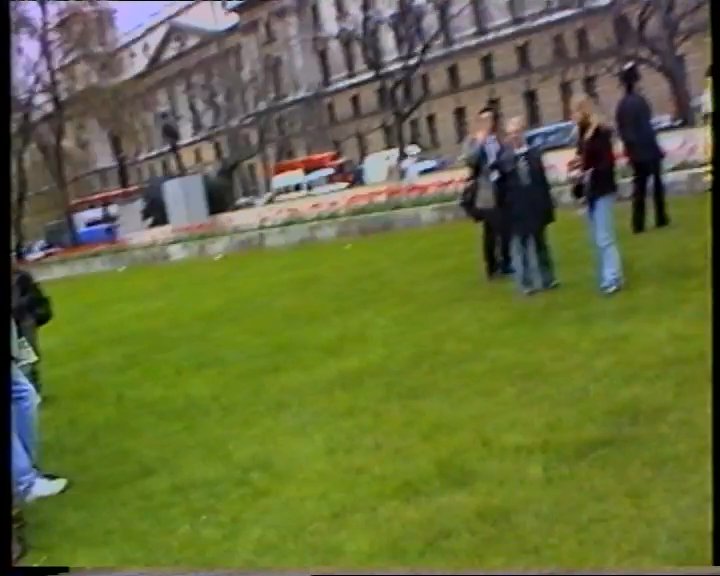
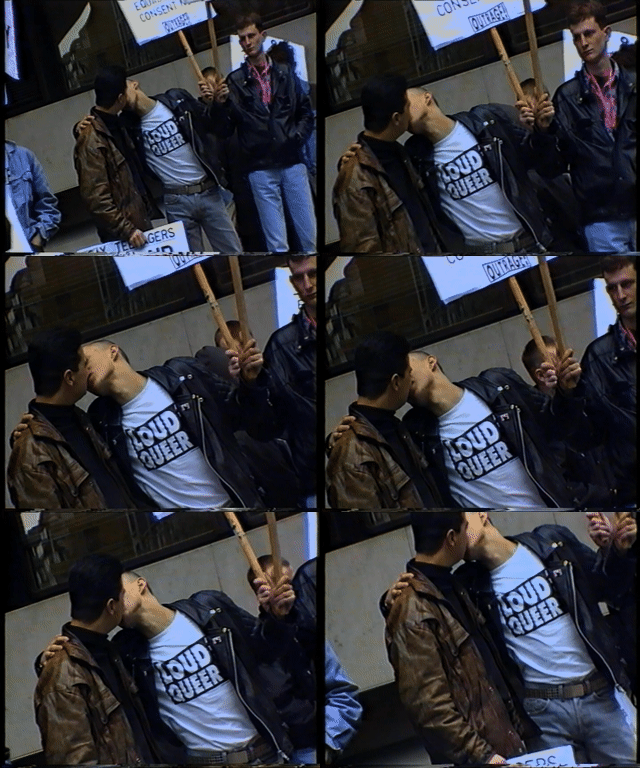
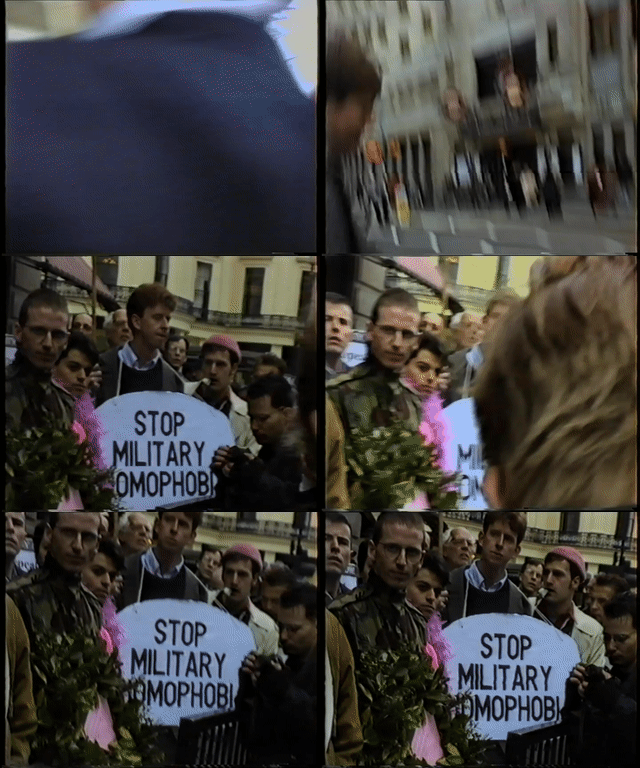
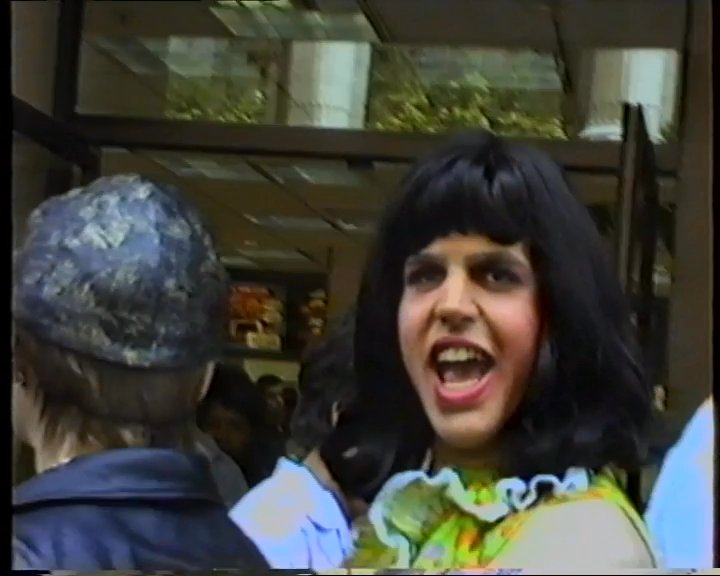
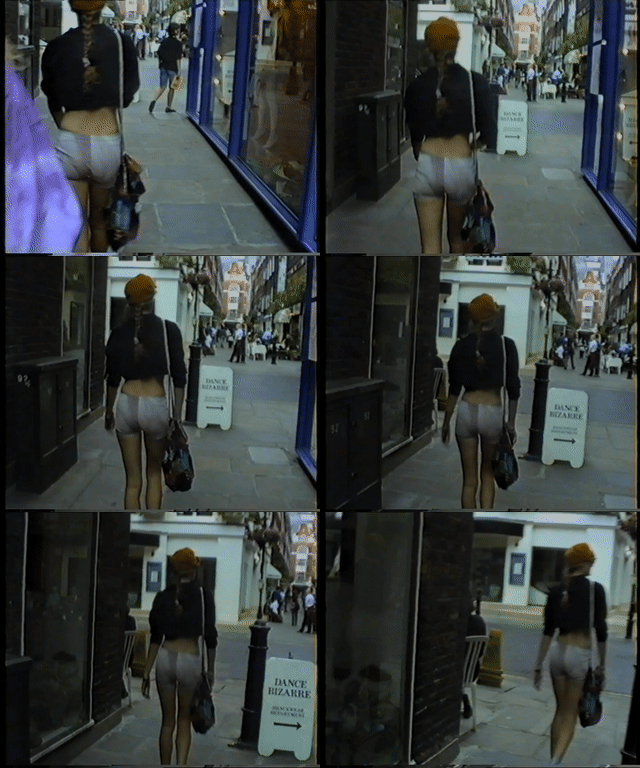
I have been getting very well acquainted with cataloguing new acquisitions, and a new collection we acquired was Mark Harriot’s footage of OutRage demos. The group was founded in 1990 by Chris Woods, Peter Tatchell, Simon Watney and Keith Alcorn, all figures we will hear from in the films this afternoon. OutRage was described as a “broad-based group of queers committed to radical, non-violent direct action and civil disobedience.”
Like all activist groups, OutRage had different factions, from socialists and assimilationists to drag queens, and I became fascinated with the British specifics of the gay and lesbian movement in the early 1990s during the years of the AIDS crisis. To be clear, I say the gay and lesbian movement as that was the definition of OutRage at the time, and I believe Britain’s gays and lesbians have a thorny history with transgender solidarity within the gay and lesbian movement, and OutRage is no exception. This is, of course, directed at the gays and institutional transphobia, not to erase trans pioneers who were marching and fighting during the period, such as Rebecca Talon De Haviland or Michelle Ross. As we will see in the feature, the contemporary queer movement and the LGB plus the T of it all came later for England.
When remembering the ongoing HIV crisis during the 80s and 90s, often the cultural hegemony of America dictates the images we remember of this history, such as the ACT UP New York die-ins or Larry Kramer’s speeches. Even when recent mainstream British culture has sought to remember the crisis, television such as It’s a Sin mimics the American imagery of activist die-ins.
Therefore, the OutRage tapes serve as a vital counter-narrative to such cultural American hegemony. This was a self-conscious decision of Harriot’s, as he utilised new handheld camcorder technology to capture OutRage demos—demonstrations that were often misrepresented or not discussed by mainstream outlets. Gay-directed video countering the mainstream discussion of AIDS was a very British concern, as Simon Watney attests that Britain’s AIDS activists were concerned with a “prevention activism” and correcting media depictions. More starkly, the director of our feature, Stuart Marshall, stated, “As far as I’m concerned, the way that AIDS has been represented by the media is nothing more than a sophisticated form of queer bashing.”
Alongside camcorder recordings, Mark also formed a collective of video artists to create a video magazine to be distributed amongst community, similar to queer video magazines in the States such as Fertile La Toyah Jackson by Vaginal Davis. This collective and magazine was called Pout, and you will see a clip from that this afternoon within the OutRage compilation, but the whole first issue will be shown on the 12th of December at the ICA.
In Mark’s videos we see iconic actions such as the protest against the gay age of consent, but also lesser-known actions such as SLAGS (Socialist Lesbians and Gays) Against The Guardian and WIG (Work It Girl), a drag protest.
Some of my favourite moments in the tapes are when you can hear the gays off-camera joking about seeing Churchill down the Admiral Duncan pub whilst strolling past his statue, or gossiping about who they went out with the night before. This all sounds like the gay nonsense I say to pepper a protest in 2025, and enlivens the protests to more than just placards and platitudes but also a part of people’s everyday lives.
I see this work as part of a wave of recent interest in queer British cultural production during the HIV crisis, such as the recent Leigh Bowery and Hammond Butt exhibitions, a new monograph on Tessa Boffin’s work, the ICA Pratibha Parmar retrospective, and the recent queer art journal Queer Art in Britain Since the 1980s. All work that this afternoon is indebted to and I’d recommend you seek out. I’d be amiss if I didn’t specially mention LCVA’s co-founder Ed Webb-Ingle’s “Do Not Tape Over” chapter of that journal, which delves further into the UK AIDS activist video.
Therefore, the OutRage tapes served for me as a creative catalyst to today’s programme. I was looking to commemorate World AIDS Day in the UK by re-remembering the specificities of the crisis here in London and how this can reveal an intergenerational queer activist and artistic lineage in.
The first video to be shown will be a short film called 21st Century Nuns by Tom Stephan, which was a student film he made whilst at the London International Film School in 1994. The figure of the Sisters of Perpetual Indulgence appears almost ubiquitously in almost all the videos today, a group of gay nuns who sought to “expiate stigmatic guilt and promulgate universal joy.” They also canonised queer figures as saints, most famously director and gardener Derek Jarman, who appears in the film and often referred to the experience as one of the happiest days of his life. One of the nuns, Mother Mandragora, otherwise known as Kel W. Farshea, will be joining us for a panel after to tell us more about the nuns and also their talking-head appearance in the feature Over Our Dead Bodies, in which they appear not as a nun but as a press officer for ACT UP London.
We will then see a safer sex film, Cock Crazy or Scared Stuff, by artist Sunil Gupta, our other guest for today’s Q&A. This film was made as part of a longer documentary film by Laura McGregor in Leicester. The film seeks to re-sexualise gay men of colour by redefining sexual acts and pleasure, counteracting the whiteness of the OutRage movement and the wider gay and lesbian scene. Sunil’s film was part of a group of contemporary Black queer cultural production that was happening alongside the OutRage movement but often was not intersected with—work such as Sankofa Film and Video Collective, Ajamu X’s photography, and Black gay activist action, such as the Black Gay and Lesbian Centre’s protest against The Voice newspaper, a Black newspaper that condemned Justin Fashanu’s coming out as a “disgrace to his family and the Black community as a whole.” We hear two white gays discuss how to show solidarity to this Black queer issue in the OutRage tapes, exposing the fissures of solidarity within the predominantly white lesbian and gay movement.
This wave of Black cultural production was influenced by debates on post-colonialism and social theory by Stuart Hall that investigated Black culture and identity within British experience during the Thatcher reign. Sunil’s film and work have constantly sought to centre queer POC experience within Britain and internationally. We will hear more from him after the.
After this, we will see the aforementioned Mark Harriot’s OutRage tapes, presented this afternoon in a new compilation edited by myself.
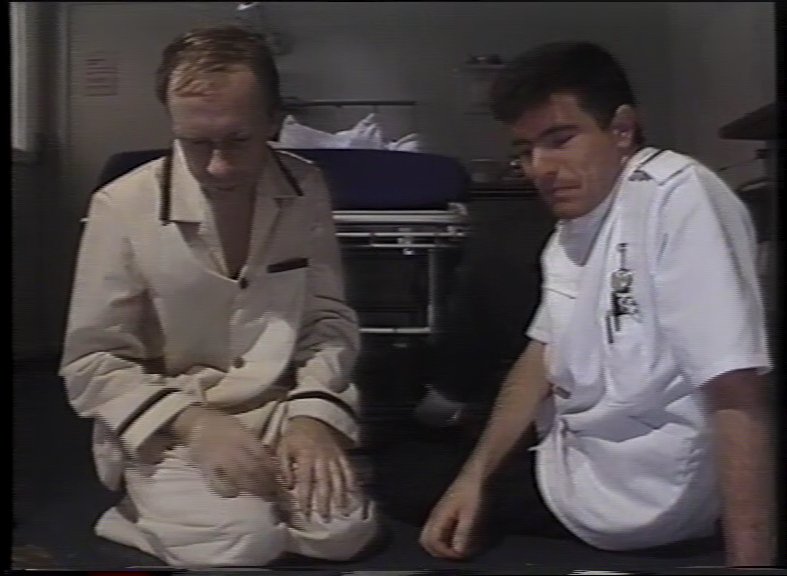
Finally, our 50-minute feature is a Channel Four documentary, Over Our Dead Bodies, directed by Stuart Marshall in 1991. Stuart Marshall was a Manchester-born gay director who made the first gay activist video from anywhere in the world in 1983 with Kaposi Sarcoma. His work was intended for the gay and lesbian community, influenced by his experience with grassroots video art organisation London Video Arts, where he programmed informal artist screenings outside of traditional institutions; he found similar spaces for gay audiences. This early activity he did was outside of broadcast television, as unlike networked local cable TV in the US, the UK had no such avenue. This allowed Stuart to market his work to specific groups with specific interest—gay media for gay people. However, by the time of Over Our Dead Bodies, he was making documentaries for Channel Four, showing the evolving media conversation around HIV. The documentary features ACT UP New York and London, OutRage and Queer Nation SF. This offers an opportunity for the OutRage tapes to be contextualised as part of a broader network of AIDS activist groups. Stuart Marshall died in 1993 of AIDS-related illness.
An often-touted thought is that the AIDS crisis killed many elders and cut off my generation from their fore-bearers. Though true to an extent, I also think it can impose a laziness on the part of younger generations to not seek out survivors and converse with their history, rather than the convenient act of ignoring it or re-writing it in your own name as a way to credit yourself as the first queer person to have done x, y or z, as often someone has done it before you—just the history has become lost or obscured. Therefore, I will be joined after to discuss this history with activists and artists Kel W. Farshea and Sunil Gupta to discuss the often undocumented history of ACT UP London, POC queer cultural production, and their experiences of the period. So please remember to stick around for that!
This afternoon should not just be an exercise in nostalgia. In 2025, HIV funding is being consistently cut in the UK, with 71% of London’s HIV voluntary, community and social enterprise organisations having to reduce staff, close services, merge with other organisations or use cash reserves to cover operating costs in the last three years. A recent report also told of the alarming increase in infection of women and Black and Asian communities, and with Trump’s recent cutting of the government’s recognition and celebration of World AIDS Day, the fight is far from over and it’s important we remember this history and work together.
LCVA profits for today’s screening will go to Love Tank’s PrEPster campaign page for the 2025 World AIDS Day Red Run. Pick up the leaflets and donate to Love Tank and Positive East. Attend the ACT UP London die-in next week—local organisations that help people with HIV.
I’d like to thank Selina and the team at Club des Femmes, the Rio staff, Andrew Woodyatt, my LCVA work wife Cici Peng, and the LCVA team.
For the people we have lost, I want to leave you with a poem Derek Jarman wrote to sign off his journal entry on the day of his sainthood. It is a poem by Siegfried Sassoon.
Everyone suddenly burst out singing;
And I was filled with such delight
As prisoned birds must find in freedom,
Winging wildly across the white
Orchards and dark-green fields; on—on—and out of sight.
Everyone's voice was suddenly lifted;
And beauty came like the setting sun:
My heart was shaken with tears; and horror
Drifted away … O, but everyone
Was a bird; and the song was wordless; the singing will never be done.